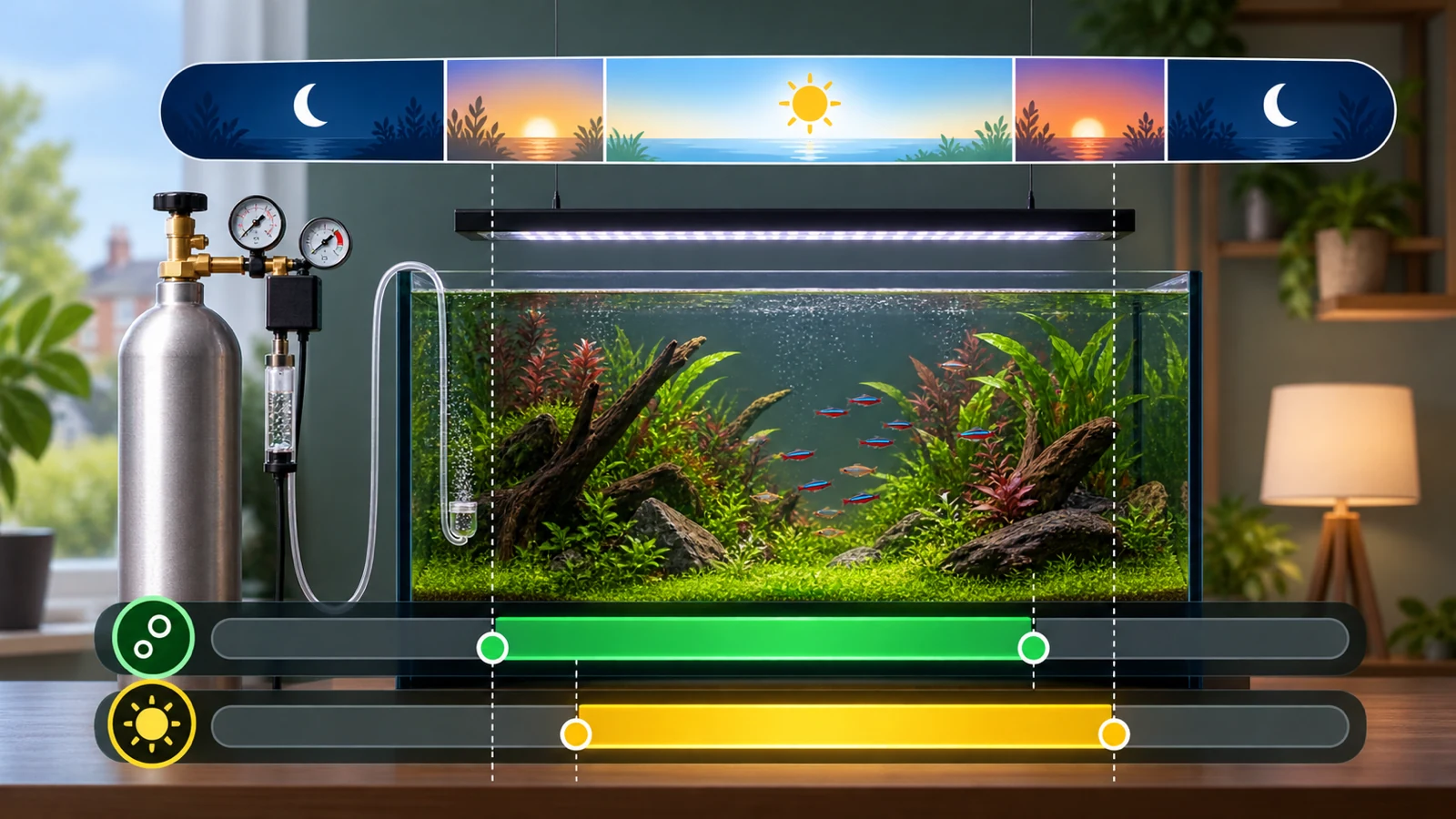
Aquarium Co2 Solenoid Timer Schedule Uk
Direct answer: as a starting schedule, turn CO2 on about 1-2 hours before the lights come on and turn it off about 1 hour before lights out. Then tune slowly with a drop checker and livestock observation, because tank volume, flow and plant load change the right bubble rate.
The goal is not to gas the tank harder. The goal is to have usable CO2 available when photosynthesis starts, then stop dosing before the dark period when plants are no longer using it in the same way.
Example 8-hour photoperiod schedules
| Lights on | Lights off | CO2 on starting point | CO2 off starting point |
|---|---|---|---|
| 10:00 | 18:00 | 08:30-09:00 | 17:00 |
| 12:00 | 20:00 | 10:30-11:00 | 19:00 |
| 14:00 | 22:00 | 12:30-13:00 | 21:00 |
Aqua Essentials gives the same broad guidance: run CO2 before lights and stop before lights out, while accounting for drop-checker lag: Aqua Essentials' UK aquarium CO2 schedule guidance.
Why a solenoid helps
A solenoid is the electric on/off valve. Aqua Essentials' solenoid product guidance describes using a domestic timer and switching CO2 around the lighting period: Aqua Essentials on solenoid timer use.
For the keeper, the front-end benefit is simple: instead of manually remembering gas every day, the timer creates a repeatable routine. You still set the flow with the needle valve and verify the tank response.
Drop-checker lag matters
A drop checker does not show the instant CO2 level. Cloud Aqua's UK guide also frames the 1-2 hour pre-lights and roughly 1 hour pre-off schedule around drop-checker colour targets: Cloud Aqua's CO2 supplementation guide.
Because of lag, avoid chasing the colour every 15 minutes. Make a small change, wait, and judge the tank as a system.
Setup checklist
- Leak-test the cylinder and regulator connection before trusting a timer.
- Set a conservative bubble rate first.
- Put the solenoid on the same daily rhythm as the lights, not overnight.
- Check fish and shrimp behaviour in the morning during the first week.
- Adjust one variable at a time: timing, bubble rate or flow, not all three.
Stop conditions
Turn CO2 down or off if fish gather at the surface, shrimp become unusually inactive, the drop checker turns yellow, or the bubble rate jumps without you touching the valve. The correct response is not to "push through"; it is to reduce gas and diagnose.
Next step
If your schedule depends on automatic on/off control, a regulator with a solenoid-ready setup is relevant. Confirm the cylinder thread first, then review the product connection options: DoublGauge Pro CO2 regulator details.
FAQ
Should CO2 be on 24/7?
For normal planted-tank use, no. Overnight dosing is usually wasteful and can increase livestock stress risk.
Is one bubble per second right?
It can be a starting point for some tanks, not a universal rule. Use drop-checker colour, plant response and livestock behaviour.