Prevent End Of Tank Dump Co2 Regulator Uk
Direct answer: end of tank dump is the feared late-cylinder failure where output pressure rises as the CO2 cylinder empties, pushing too much gas into the aquarium. You reduce the risk by using a regulator design with stable pressure behaviour, checking the working-pressure gauge as the bottle runs down, and treating sudden bubble-rate changes as a stop-and-check event.
This article is deliberately not a product guarantee. If a regulator page does not clearly state how it controls pressure near the end of a cylinder, do not infer that it prevents end of tank dump.
What actually changes near the end of the cylinder
In hobby language, the concern is that a simple single-stage regulator may lose stable control as cylinder pressure falls. UKAPS aquascapers discuss this as a bigger risk on larger cylinders such as 2 kg fire extinguishers than on tiny disposable cartridges: UKAPS discussion of end-of-tank dump prevention.
Single-stage, dual-stage and dual-gauge are not the same claim
A dual-stage regulator reduces pressure in two steps and is commonly marketed as a way to keep output steadier across the cylinder life. CO2 Supermarket describes dual-stage output stability and dual gauges for input and working pressure on its UK product page: CO2 Supermarket on dual-stage regulator behaviour.
Finest Aquatics uses similar wording for dual-stage pressure control in its CO2Art listing: Finest Aquatics on dual-stage CO2 regulation.
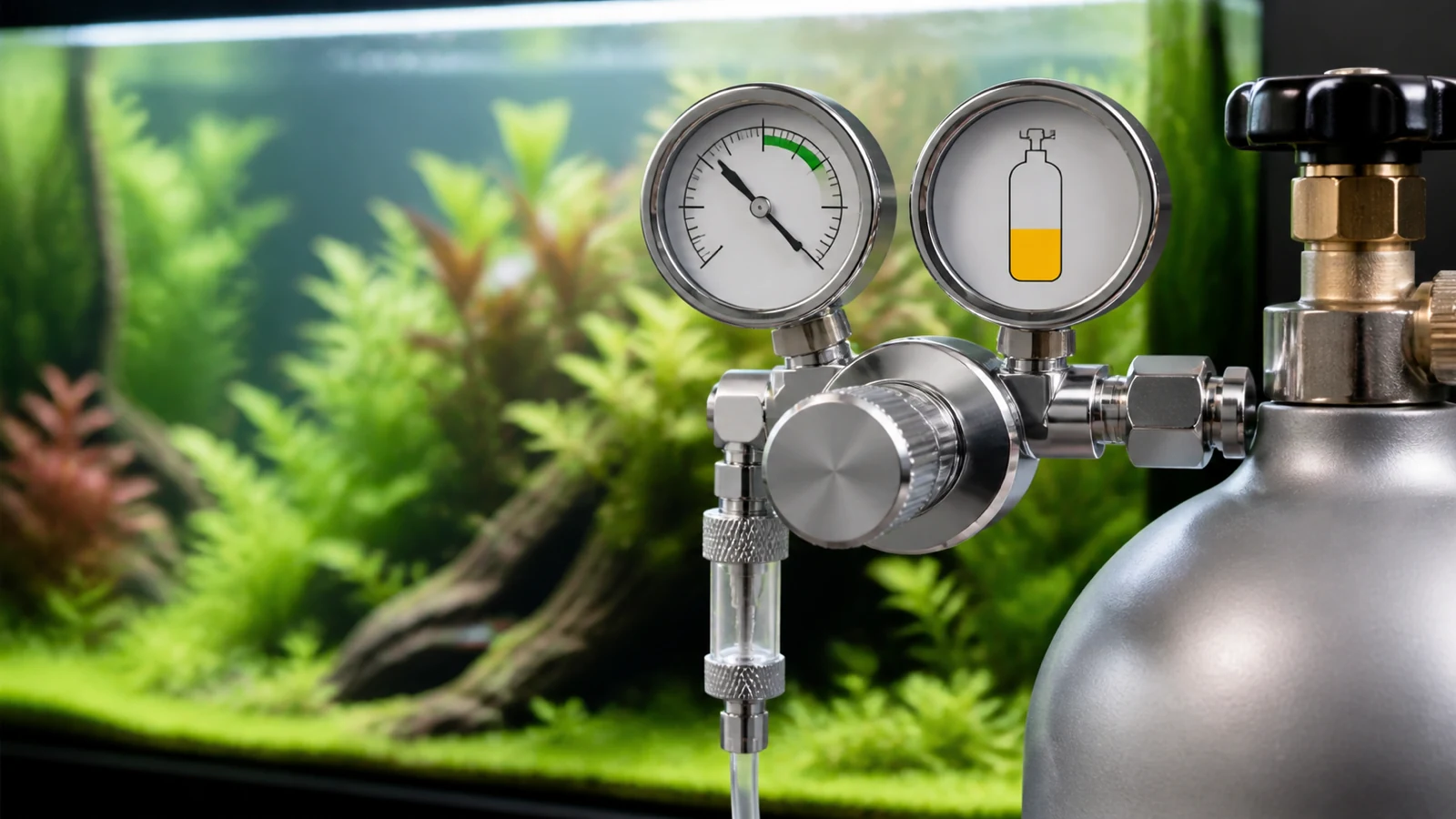
A dual-gauge regulator, by contrast, means there are two dials: one can show cylinder pressure and one can show working pressure. Dual gauges help you monitor, but they are not the same as a verified dual-stage design.
Daily diagnostic ladder
- Normal week: record your usual working pressure and bubble rate after setup is stable.
- Cylinder getting low: check the high-pressure gauge more often and watch for unexpected changes.
- Bubble rate rises without adjustment: turn off CO2, check livestock, and inspect the regulator before restarting.
- Drop checker turns yellow or fish gasp: stop CO2, increase aeration, and do not resume until the cause is understood.
Who has the highest reason to care?
Prioritise this if you run a larger refillable cylinder, a high-light tank with sensitive livestock, or a setup where the cylinder is hidden and rarely checked. It is less central for tiny disposable cartridges, where the total gas mass is much smaller, though stability still matters.
Buying rule
Ask two separate questions: "How does this regulator control pressure?" and "Can I see both cylinder and working pressure?" A product with two dials may answer the second question but not the first. If the product page does not support an end-of-tank-dump prevention claim, treat it as unverified.
FAQ
Can a gauge prevent end of tank dump by itself?
No. A gauge shows information. Prevention depends on regulator behaviour, setup, maintenance and the user noticing drift.
Should I run CO2 overnight to avoid pressure changes?
No. Overnight injection can stress livestock and wastes gas. Use a suitable solenoid schedule and monitor the system instead.